
The 90-Second Enterprise: How to Answer B2B Customers in Minutes Without Letting AI Guess
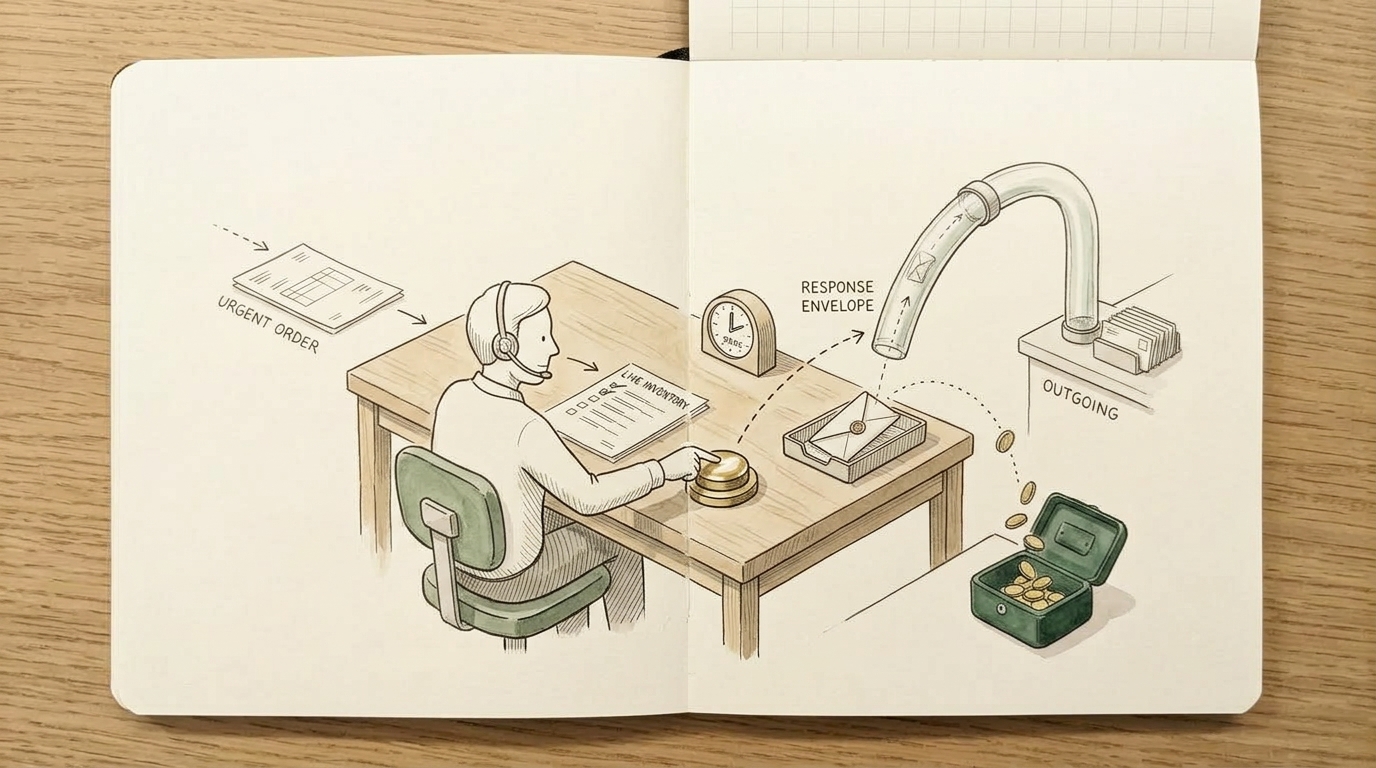
In mid-market manufacturing, distribution, and commercial services, customer relations live and die by responsiveness. Yet every day, inbound RFQs, inventory inquiries, delivery status requests, and technical questions sit trapped in shared email inboxes for eight to twenty-four hours while account managers play human router. Reps lose half their shift hunting down warehouse supervisors, checking ERP stock tables, and manually drafting replies.
B2B buyers do not wait. When an operational reply takes twenty-four hours, the customer has already issued a purchase order to a faster competitor.
Deploying a generic chatbot is not the answer. Rigid decision-tree bots infuriate professional buyers, while raw language models hallucinate stock counts and quote unauthorized discounts.
Real responsiveness requires software discipline: using language models strictly to parse messy incoming requests, while delegating inventory verification, contractual pricing, and delivery rules to rule-checked code running outside the AI.
By combining contextual parsing with zero-guesswork database verification, mid-sized companies can respond to customer requests in ninety seconds while keeping consequential decisions firmly under human review.
The Conventional Breakdown: Brittle Keyword Bots vs. The Danger of Raw LLMs
When mid-sized businesses attempt to accelerate customer response times, they usually stumble into one of two operational traps.
The first trap is deploying legacy decision-tree bots or keyword help-desk widgets. These systems force commercial clients through rigid menus: “Press 1 for tracking, Press 2 for billing.” In enterprise transactions, customer inquiries are rarely clean. A customer emails:
“We have a shutdown on Line 4 at our Cleveland site. We need 400 linear feet of reinforced nitrile hose (Part #NH-400-R) by Wednesday morning under our blanket agreement, and we need confirmation that the batch meets ISO 9001 certification.”
A keyword bot cannot parse this. It triggers an error rule, presents an irrelevant FAQ article on return policies, and routes the ticket into an unread general support queue. The buyer gets frustrated, picks up the phone to call an alternate distributor, and the relationship erodes.
The second trap is deploying an unconstrained large language model directly to customer communication channels. Over the past eighteen months, many companies tested AI customer assistants by connecting a raw model to an email address or live chat.
In a live B2B environment, an unconstrained model is a direct liability to the CTO and CFO for three concrete reasons:
- Hallucinated Inventory and Delivery Commitments: Language models predict likely tokens; they do not maintain transactional state. A raw model asked about delivery deadlines will casually promise arrival by Wednesday without verifying whether the supplier warehouse has physical inventory on hand or if freight carriers are booked.
- Margin Erosion and Unauthorized Discounts: If a procurement manager writes, “We were promised a 15% volume concession on this run,” an unconstrained LLM often complies to be helpful. It drafts an affirmative response, creating an accidental commercial commitment that eats operating margin.
- Unvalidated Writes to Core Systems: Allowing a language model to update order records or modify ticket statuses directly in an ERP or CRM without external schema checks invites data corruption and breaks compliance audit trails.
The commercial cost of slow response times is severe. Research published by the Harvard Business Review on B2B lead response shows that organizations contacting inquiries within five minutes are 21 times more likely to qualify and advance the opportunity than those waiting thirty minutes. When response latency stretches past four hours, win rates drop by more than 60%.
From a direct labor perspective, APQC operational benchmarks show that manual processing and routing of complex customer inquiries costs mid-market companies between $18.50 and $32.00 per incident. With a digital worker handling ingestion, database verification, and pre-drafting, unit handling cost drops to $3.20 to $5.50 per incident, while First Response Time (FRT) drops from hours to under two minutes.
The System Architecture: Separating Conversational Context from Hard Business Rules
At Acumen, we build digital workers on an explicit engineering boundary: Language models read and write natural language; deterministic software code verifies facts, enforces policy, and calculates numbers.
A customer service digital worker must never be allowed to guess an inventory count or invent a price. We structure the ingestion and response pipeline into four isolated layers:
[ Inbound Customer Inquiry (Email / Portal / RFQ PDF) ]
                          │
                          ▼
┌────────────────────────────────────────────────────────┐
│         Contextual LLM Ingestion & Intent Parser       │
│  • Normalizes multi-part unstructured requests         │
│  • Extracts SKUs, quantities, delivery deadlines, SLAs │
│  • Emits strict, typed JSON schema with citations      │
└────────────────────────────────────────────────────────┘
                          │
                          ▼
┌────────────────────────────────────────────────────────┐
│      Deterministic Grounding Engine (Outside LLM)      │
│  • Scoped Read-Only ERP Query (live warehouse inventory)│
│  • Deterministic Pricing & Tier Policy Rule Engine     │
│  • Customer Credit Limit & SLA Compliance Check        │
└────────────────────────────────────────────────────────┘
                          │
         ─────────────────┴─────────────────
        │                                   │
  [ In-Policy & Verified ]          [ Variance / Ambiguity ]
        │                                   │
        ▼                                   ▼
┌─────────────────────────┐       ┌─────────────────────────┐
│ Staged Response Feed    │       │ Ambiguity Gate & HITL   │
│ (One-click rep approval │       │ (Pre-computed card for  │
│ or automated send)      │       │ Account Exec in 45s)    │
└─────────────────────────┘       └─────────────────────────┘
Here is how the responsibilities divide:
- What the LLM Handles: The language model reads the incoming email and any attached purchase specifications. It extracts the customer account ID, the requested part numbers, required delivery dates, and specific quality requirements. It outputs this data into a typed JSON schema.
- What Deterministic Code Handles: A dedicated service running outside the model takes that JSON schema and performs exact lookups:
- It checks the ERP for live inventory across regional distribution centers.
- It cross-references the customer’s master contract to pull their negotiated discount schedule.
- It calculates shipping lead times and freight costs using exact carrier tables.
- It checks customer credit status in accounting.
- Access Boundary and Data Residency: The entire pipeline executes within a private VPC. The digital worker connects to internal ERP and CRM systems strictly via read-only APIs. No customer communication data is ever used to train public models, and zero database write commands are executed without human review or strict schema validation.
If the inquiry is routine, fully in-stock, and within policy, the system stages a complete, polite, and citation-backed response in the account manager’s inbox within thirty seconds. The rep reads the draft, confirms it with one click, and the customer receives an accurate answer in under ninety seconds.
The Ambiguity Gate: Human Authority at Points of Conflict
In enterprise operations, edge cases are normal. Real customer inquiries frequently present contradictions, tight deadlines, or custom requests that fall outside standard parameters.
An automated system must never attempt to resolve commercial ambiguity by itself. When data conflicts or policy boundaries are reached, the pipeline halts straight-through processing and routes the variance to an Ambiguity Gate.
Consider a practical example from an industrial parts supplier:
A Tier-1 mechanical contractor sends an urgent email at 4:15 PM:
“We have an emergency retrofit job starting Thursday morning in Chicago. We need 600 units of Hydraulic Seal Kit (Part #HS-902). We need them delivered to our O’Hare job site by 8:00 AM Thursday, and we expect our negotiated 15% tier discount on the full order.”
A naive AI chatbot might check total company inventory, see 720 units somewhere in the national system, apply the 15% discount, and reply: “Confirmed! Your 600 units will arrive Thursday morning at 15% off.”
That response would create an operational crisis:
- Chicago only has 420 units on the shelf. The remaining 300 units are in an Indianapolis warehouse and require forty-eight hours for standard freight transfer.
- The contractor’s master service agreement specifies a 10% discount on orders under 1,000 units. A 15% discount creates a $1,440 margin shortfall that requires regional sales director authorization.
Acumen’s digital worker does not hallucinate a promise. Its rule engine catches two specific variances: an inventory split across locations and an unapproved discount threshold.
The system halts automated delivery and immediately produces an Ambiguity Review Card for the assigned Account Director:
┌────────────────────────────────────────────────────────────────────────┐
│ AMBIGUITY REVIEW CARD: ORDER #HS-902 RETROFIT                          │
│ Customer: Great Lakes Mechanical (Tier-1 Account)                      │
├────────────────────────────────────────────────────────────────────────┤
│ VARIANCE 1: INVENTORY LOCATION SPLIT                                   │
│ • Requested: 600 units by Thursday 8:00 AM (Chicago Job Site)          │
│ • Local Chicago Stock: 420 units (Available immediately for courier)   │
│ • Secondary Stock: 300 units in Indianapolis (Requires expedited van)  │
│                                                                        │
│ VARIANCE 2: DISCOUNT THRESHOLD EXCEPTION                               │
│ • Requested: 15% volume discount                                       │
│ • Contract Baseline: 10% on orders < 1,000 units                       │
│ • Commercial Impact: 5% delta = $1,440.00 margin difference            │
├────────────────────────────────────────────────────────────────────────┤
│ PRE-COMPUTED OPTIONS READY FOR 1-CLICK APPROVAL:                       │
│ [Option A]: Split Shipment. Release 420 units from Chicago for         │
│             Thursday 8 AM delivery. Dispatch 180 units from Indy via   │
│             hot-shot courier for Thursday 1 PM arrival. Apply 12% split│
│             compromise discount.                                       │
│ [Option B]: Standard Route. Release 420 units Thursday morning;        │
│             ship remaining 180 units standard ground for Friday arrival│
│             at standard 10% contract terms.                            │
└────────────────────────────────────────────────────────────────────────┘
The Account Director receives an alert on their desktop or mobile device within two minutes of the customer’s email.
Instead of spending forty-five minutes logging into three different systems, calling the warehouse manager, and doing manual margin math, the director reviews the pre-computed card in forty-five seconds.
They tap Option A. The system instantly compiles a professional, fully detailed response to the contractor detailing the exact two-stage delivery schedule and pricing breakdown, and queues the internal warehouse transfer requests in draft status.
The customer receives an honest, workable, verified solution in under four minutes. Trust is strengthened, operational chaos is avoided, and commercial margin is protected.
The Progressive Trust Roadmap: Evidence Before Access
Enterprise leaders cannot afford to hand customer communication over to an unproven black box. Adopting digital workers must be an incremental, measurable progression where every step proves reliability before access expands.
Acumen deploys customer response automation through a six-stage architecture:
Stage 1: Establish First Proof
└── Test 20–50 historical customer email threads offline.
    Verify extraction accuracy and rule matching with zero production access.

Stage 2: Confirm the Fit
└── Review edge cases with customer service and sales leads.
    Calibrate discount limits, inventory thresholds, and escalation rules.

Stage 3: Run a Controlled Pilot (Shadow Mode)
└── The digital worker ingests live incoming emails and drafts complete responses.
    Human account reps inspect 100% of staged drafts before anything is sent.

Stage 4: Connect Approved Systems
└── Introduce role-bounded, read-only API connectors to ERP and CRM systems
    to enable live inventory checks, order tracking lookups, and account tiering.

Stage 5: Enable Approved Actions
└── Grant autonomous sending authorization solely for low-risk, verified queries
    (order tracking, spec sheet lookups). Commercial commitments remain staged for rep sign-off.

Stage 6: Expand Proven Automation
└── As straight-through accuracy consistently clears 98%, broaden autonomous categories,
freeing account managers to focus on high-touch client relationships and revenue growth.- Establish First Proof: We begin offline. You provide 20 to 50 anonymized historical customer inquiry emails and your standard product reference sheets. We run our extraction and deterministic validation pipeline offline. We show you exactly how the system parses multi-part inquiries, matches SKUs, and isolates edge cases. Zero access to your live systems.
- Confirm the Fit: We sit down with your operational leads to review the offline results. We calibrate your business rules: acceptable inventory thresholds, discount authorization tiers, and escalation paths for high-value accounts.
- Run a Controlled Pilot: We deploy the digital worker in Shadow Mode. The system monitors incoming customer inquiries and prepares draft responses directly inside your reps’ email or ticketing queue. Human staff review 100% of outbound messages. We track draft acceptance rates, time saved, and response latency.
- Connect Approved Systems: We configure scoped, role-bounded read-only API connections to your ERP (such as NetSuite, SAP, or QuickBooks) and CRM. The digital worker can now query live stock levels, open orders, and customer pricing agreements without human data lookups.
- Enable Approved Actions: Once accuracy is proven over hundreds of live inquiries, the system is authorized to send direct replies for bounded, low-risk requests—such as shipping tracking links, standard product spec sheets, and stock availability confirmations. Any inquiry involving pricing adjustments, custom delivery guarantees, or complaints remains strictly staged for human sign-off.
- Expand Proven Automation: As the system consistently demonstrates zero-defect performance on proven paths, straight-through processing thresholds are tuned. Your team transitions from typing routine status updates to handling high-value customer relationships and strategic sales.
The Operational Balance Sheet: What 90-Second Responsiveness Delivers
When customer responsiveness moves from twenty-four hours to ninety seconds, the operational impact compounds across the entire business:
| Operational Dimension | Conventional Manual Triage | Acumen Digital Worker (Zero-Guesswork AI) |
|---|---|---|
| First Response Time (FRT) | 8 to 24 hours | Under 90 seconds (routine) / Under 4 mins (complex) |
| Cost per Inbound Inquiry | $18.50 – $32.00 (manual labor drag) | $3.20 – $5.50 (rule-checked pipeline) |
| Inventory & Pricing Accuracy | Variable (reps rely on memory or stale sheets) | 100% Verified against live ERP records |
| Account Rep Daily Capacity | 35 to 50 inquiries per day (fatigued) | 150+ inquiries per day with pre-drafted review cards |
| Quote-to-Order Conversion | Baseline | +28% to +40% increase from speed-to-lead advantage |
| Human Review Gate | Full manual assembly (12–15 mins) | Rapid isolated sign-off (45–60 seconds) |
By taking the repetitive data lookup and drafting burden off your account managers, you do not just cut operational costs. You protect your team from burnout and ensure that your best customers always receive immediate, professional, and accurate service.
Discuss a Controlled First Proof
If your sales and support teams are overwhelmed by customer inboxes and response times are costing you business, do not embark on a multi-month CRM transformation. Start with a bounded, inspectable proof.
- Offline Sample Workflow Run: Send 20 to 30 anonymized customer inquiry threads or order emails to business@acumen.llc. We will demonstrate deterministic extraction, live policy validation, and staged response generation offline without touching your production systems.
- 15-Min Technical Strategy Call: Schedule a direct architecture review with our Lead Architect to assess workflow suitability, data residency requirements, and operational feasibility.