

Most local AI tutorials casually assume a $3,000 workstation with an RTX 4090 or 64GB of unified memory. The conventional narrative insists that autonomous, tool-using agents handling deep document parsing and multi-step workflows require enterprise-grade hardware.
That sidelines millions of everyday users, tinkerers, and curious builders.
Many of us have a baseline 8GB machine sitting right in front of us — an everyday laptop, an office mini PC, or, in my case, an 8GB M1 Mac Mini gathering dust on my desk.
Earlier attempts at running local LLMs on my primary MacBook Air were haphazard: an ad-hoc script here, an Ollama pull there, usually ending in pinned CPU cores, thermal throttling, unresponsive tabs, or running completely out of memory. It disrupted daily work and lacked reproducibility.
I decided to put that idle Mac Mini to dedicated use. Rather than treating an entry-level 8GB box as an interactive chat client, I turned it into a headless workhorse. The mission was an exercise in maximal optimization: squeezing every megabyte of RAM, compute cycle, and memory bandwidth out of baseline silicon.
The goal: build a reliable, reproducible setup for autonomous agent harnesses like Hermes, OpenClaw, or custom web-scraping pipelines. I wasn’t optimizing for sub-second chat latency for human conversation. I needed a headless inference engine that could run continuously for days: scraping the web, parsing unstructured pages, and taking structured notes without crashing, leaking memory, or hallucinating.
If baseline 8GB hardware can survive this through disciplined optimization, it provides an architectural blueprint for resource-constrained local inference everywhere.
The Reality of Agent Frameworks: The Context Tax
Switching from conversational chat to autonomous agent harnesses reveals a harsh constraint: agent prompts are massive.
Even for a tiny query — like “extract the price table from this webpage” — the payload is enormous because agent frameworks wrap requests in extensive scaffolds:
- Tool definitions and strict JSON execution schemas.
- System persona constraints and environment variables.
- Multi-step scratchpads and memory instructions.
- Error-recovery policies and multi-turn execution histories.
Because of this preamble, modern agent frameworks realistically demand a 32K context window.
In local inference, context translates directly into memory. Sequence length scales into the Key-Value (KV) cache, storing attention states to avoid recomputation on autoregressive steps:
For a standard FP16 (16-bit float) cache, holding a 32K context consumes 4.5 GB to 8.0 GB of RAM just for attention states — before loading a single byte of model weights.
The Software Hurdles: Why LM Studio and Ollama Let Me Down
I started where most people begin: LM Studio and Ollama. Both failed under headless, long-running agent workloads on constrained hardware.
LM Studio is desktop-oriented. Its Electron UI wasted hundreds of megabytes of resident memory on window frames and animations — precious RAM needed for tensor graphs. It also obscured low-level allocation controls behind simplified toggles.
Ollama was worse: it actively interfered with configuration.
Deterministic context length is non-negotiable for agent harnesses. When I configured context length to 32K (and later 16K) via Modelfiles and API requests using num_ctx, Ollama silently clamped it to 8K (or an arbitrary heuristic value). Silently truncating earlier tokens caused tool execution schemas and instructions to vanish mid-run.
Under the hood, both tools wrap llama.cpp. Realizing the abstractions hid critical failure modes and wasted memory, I uninstalled both and switched directly to bare-metal llama-server.
The Initial Contenders: What Models I Was Eyeing (and Why)
Autonomous agents leave zero margin for hallucinated syntax, missing tool call brackets, or drifting instructions.
Online consensus champions Qwen2.5-Coder (or Qwen2.5 Instruct) for local coding and agents. In past trials on this 8GB machine, however, Qwen’s output was never reliable enough for Hermes or OpenClaw, exhibiting syntax degradation, dropped tool schemas, and drift under long-context instructions despite snappy speeds.
Conversely, earlier experiments with Gemma-4-E2B showed noticeable latency but undeniable output quality: structural coherence, instruction fidelity, and schema compliance were exceptionally high. I was already leaning toward the Gemma family.
Still, I kept an open mind. Evaluating Microsoft’s Phi ecosystem, full Phi-4 (14B) was an immediate non-starter: its repo was in PyTorch bnb-4bit (incompatible with llama.cpp), and a GGUF quant would require ~8.8 GB for weights alone, exceeding physical RAM on paper. That pointed me to Microsoft’s Phi-4-mini (3.8B): a compact synthetic reasoning model fitting inside my ~2.4 GB weight budget.
My initial candidate board:
- The Compact Contenders (Phi-4-mini 3.8B, Qwen2.5-Coder-3B, DeepSeek-R1-Distill-Qwen-1.5B): Promising reasoning within ~2.0 GB to 2.5 GB footprints, offering distilled chain-of-thought or high-density synthetic data.
- The Quantization-Aware Trained Family (Gemma-4-E2B and E4B with MTP): Unlike Post-Training Quantization (PTQ) that rounds weights after the fact, Google DeepMind and Unsloth’s Gemma-4 QAT checkpoints were trained directly with low-precision integer noise. They bundled native Multi-Token Prediction (MTP) draft heads inside the GGUF container, enabling speculative decoding without loading a second model into RAM.
Why 32K Context Would Not Fit: The Math of an 8GB Box
Evaluating candidate models against bare-metal llama-server made the physical limitation clear: a 32K context cannot fit on an 8GB machine, regardless of model or runtime:
- Model Footprint: A compact 3B/4B model quantized to 4-bit requires ~2.0 GB to ~3.2 GB.
- The 32K KV Cache: Standard FP16 context demands 5.0 GB to 8.0 GB of RAM; even at 8-bit, it takes 2.5 GB to 4.0 GB.
- The OS Baseline: Modern operating systems with unified graphics require 2.0 GB to 3.0 GB for stability (kernel, display compositing, network daemons).
The arithmetic for a 4B model with 32K context fails immediately:
Attempting this allocation immediately triggered hard Metal aborts:
error: Insufficient Memory (00000008:kIOGPUCommandBufferCallbackErrorOutOfMemory)To make an 8GB machine viable for agentic workloads, I had to squeeze every parameter and redefine boundaries.
The Quantization Gamble: Squeezing Tensors into 3 GB
From the start, quantization was my primary lever to achieve a ~3 GB weight footprint. Full-precision (FP16/BF16) models are completely out of the question on shared-memory hardware.
Trade-Offs: Memory Compression vs. Representational Fragility
Quantization slashes weight memory from 16-bit to 4-bit by ~75%, allowing 4B-parameter models to fit into ~2.5–3.2 GB. Because token generation is memory-bandwidth bound, pulling fewer bytes per forward pass directly boosts tokens per second.
Aggressive compression carries risks — especially on compact 2B to 4B models:
- Representational Fragility: Unlike 70B models where redundant parameters absorb rounding noise, 2B–4B models carry high informational density per weight. Uniform quantization rounds off critical outliers, causing syntax bugs, dropped formatting tags, and attention degradation across long sequences.
- Speculative Misalignment: In speculative decoding, post-quantization noise creates drift between draft logits and base verifications, cratering acceptance rates.
Unsloth’s Dynamic Quantization & QAT
Unsloth’s Dynamic Quantization (UD-Q4_K_XL, UD-Q4_K_M) addressed this. Rather than applying blanket block quantization, Unsloth keeps sensitive tensors (embeddings, RMSNorm, query/key heads) at higher precision (Q5/Q6/FP16) while squeezing bulk FFN down-projections into 3-bit or 4-bit blocks using targeted importance matrices (imatrix).
Quantization-Aware Training (QAT) takes this further by simulating discrete 4-bit lattices during training. Packaging these Gemma QAT checkpoints into UD-Q4_K_XL provided the ideal blueprint: a dense ~4B model running inside ~3.1 GB of RAM that maintains attention contrast across long contexts and preserves speculative draft accuracy.
Maximizing Available Memory: System Purge and GPU Defaults
Modern macOS requires 2.0 to 2.5 GB for the kernel, WindowServer, and background tasks. I needed to reclaim every megabyte of resident memory and allocate the largest safe memory pool to the GPU.
***A Note on Operating System Specifics:**The OS commands detailed below (
*iogpu.wired_limit_mb*,*purge*,*mdutil*) are Darwin/macOS specific. However, host OS tuning is not the critical element of this project—it is merely table stakes. Carving out an extra 700 MB of RAM will not save you if your runtime parameters blow up your scratch buffers or if your model collapses into repetitive loops under 4-bit quantization. The true determinant of success is the selection of the right model architecture and the *deliberate calibration of inference optimization parameters on performance and quality.
- Purging Caches & Disabling Indexing:
- I closed non-essential apps, ran
sudo purgeto flush inactive page caches and dirty disk buffers, and paused Spotlight search indexing (sudo mdutil -a -i off) to prevent background memory spikes. - Overriding Darwin’s Wired GPU Limit (
**iogpu.wired_limit_mb**): - Checking Darwin kernel parameters revealed a built-in ceiling:
sysctl iogpu.wired_limit_mb hw.memsize
iogpu.wired_limit_mb: 0
hw.memsize: 8589934592 (8.0 GB)- The default
0dynamically restricts wired GPU allocations to ~65–68% of RAM (~5.2 GB to ~5.4 GB on an 8GB machine), reserving the rest for system stability. Startup allocations with weights, scratch buffers, and attention states regularly hit that ceiling. I overrode it:
# 1. Raise Metal GPU wired memory limit to 6.0 GB
sudo sysctl iogpu.wired_limit_mb=6144
sudo sh -c 'echo "iogpu.wired_limit_mb=6144" >> /etc/sysctl.conf'

# 2. Flush inactive disk and page buffers
sudo purge

# 3. Disable Spotlight indexing to prevent background RAM spikes
sudo mdutil -a -i off
Setting this limit to 6,144 MB gave the GPU ~700 MB of extra headroom while preserving ~2.0 GB for macOS.
Hardware Telemetry: Setting Up macmon Before Execution
Operating near physical limits requires real-time telemetry.
Activity Monitor proved unhelpful: it provides a vague 2D GPU history bar, omits compute residency, clock speeds, and memory bandwidth, and hides the Apple Neural Engine (ANE/NPU) entirely.
I turned to **macmon**—a zero-overhead TUI written in Rust for Apple Silicon telemetry:
brew install macmon
sudo macmon
Running macmon provided direct, unvarnished insight into the M1 under inference load:
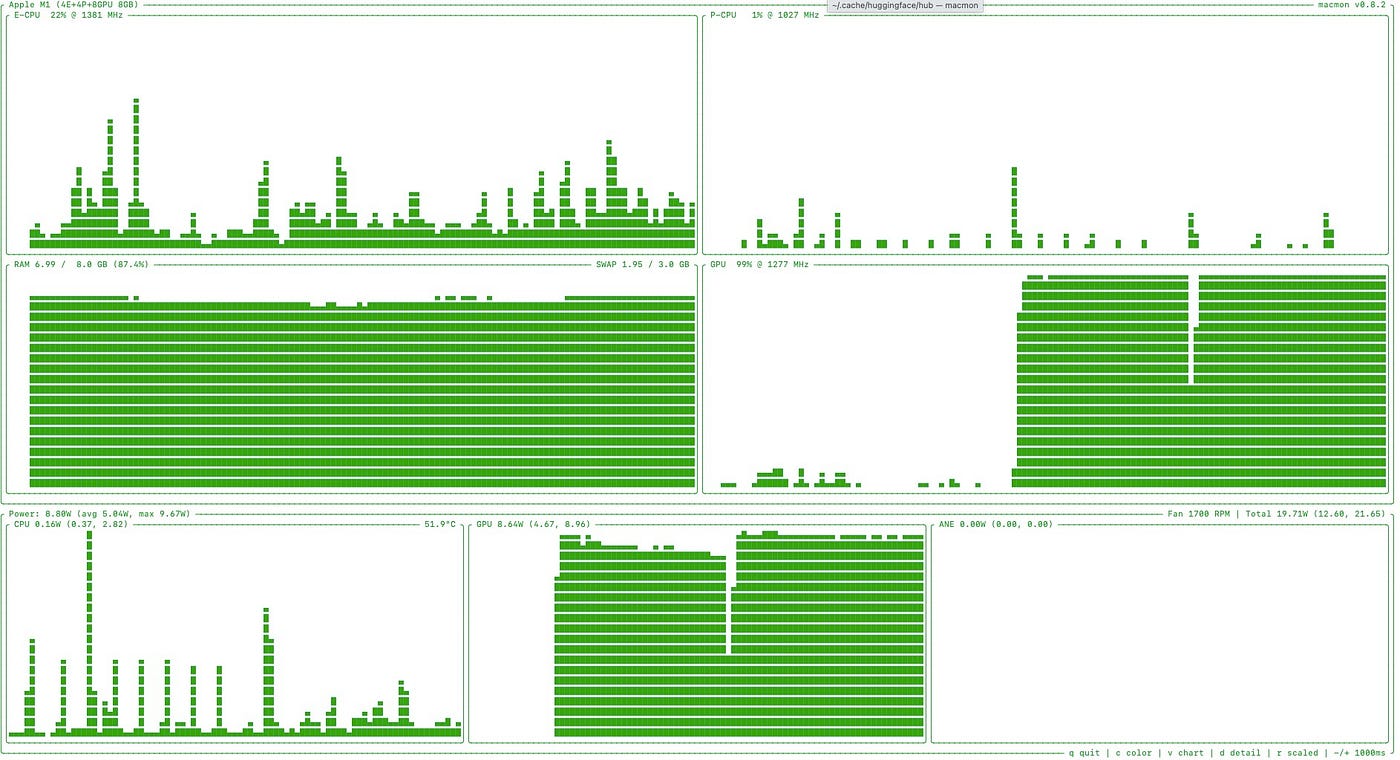
Key takeaways from the live telemetry dashboard:
- Why the NPU Sat Idle at 0.00W:
llama.cppmaps operations directly to Metal compute shaders (ggml-metal.metal). The ANE lacks a public C/C++ API, requires fixed-dimension graphs, and cannot handle dynamic 4-bit KV caching. - The 99–100% GPU Wall: During inference, the GPU frequency pinned at 1277 MHz and residency surged to 99% (drawing ~8.64W), while the Performance CPU cores hovered near idle at 1% @ 1027 MHz. This confirmed zero CPU-to-GPU dispatch bottlenecks. In autoregressive decode on Apple Silicon, a pinned GPU indicates that memory bus interfaces are completely saturated, pulling weights and cache lines at maximum throughput per step.
- The Swap Balance: RAM stabilized at 6.99 / 8.0 GB (87.4%), with inference memory locked via
--load-mode mlock. macOS safely offloaded 1.95 GB of idle background system processes into SSD swap, protecting active DRAM for KV evaluation without paging thrash.
Defining My Non-Negotiable Requirements
With system preparation complete, I established five non-negotiable operational requirements:
- A 16K Context Floor: Dropping below 16K was unacceptable. Hermes and OpenClaw require significant headroom for system schemas, tool definitions, and multi-turn web scrapes.
- Empirical Qualitative Reliability: The model had to extract parameters with 100% accuracy, preserve strict JSON schemas, adhere to negative constraints (“without preamble”), and write compiling code without syntax drift.
- Maximized Unified Memory for the GPU: Locked in at 6.0 GB via kernel overrides, with system caches purged.
- Zero Overhead for Multimodal Weights: Headless agents are strictly text-based. Eliminating audio/vision projectors freed 1.5 to 2.0 GB of RAM for language context.
- Minimum Sustained Throughput of 15 Tokens/Second: For autonomous agents running overnight loops, sub-15 t/s throughput creates multi-hour bottlenecks.
The Optimization Toolkit: Squeezing Every Knob in llama.cpp
Unlike OS-level tuning, llama.cpp runtime flags are cross-platform levers that dictate the mathematical realities of inference. Every flag you set has a direct, measurable consequence on memory residency, prefill latency, generation speed, and token degradation:
1. Always-Mandatory Flags
**--gpu-layers 999**** (**-ngl 999**):** Offloads 100% of transformer layers to Metal shaders, running tensor math via zero-copy shared buffers in DRAM and keeping CPU compute duty at 0%.**--flash-attn on**** (**-fa**):** Replaces standard attention calculations with fused Metal kernels. It computes attention block-by-block in GPU threadgroup memory, eliminating intermediate activation matrix memory spikes during prefill.**--no-mmproj**: Explicitly preventsllama-serverfrom downloading and loading auxiliary multimodal projector files (mmproj-BF16.gguf), reclaiming ~2.0 GB of unified RAM for text context.**--parallel 1**** (**-np 1**):** Restricts the server to a single concurrent slot, preventing context memory from scaling multiplicatively.
2. Trade-Off Flags: Keys vs. Values (-ctk and -ctv)
Compressing the 16K KV cache from FP16 (~4.5 GB) down to 4-bit (q4_0) drops its footprint to ~1.1 GB—saving ~3.4 GB of RAM:
- Values (
**-ctv q4_0**): Pure win. Values undergo weighted accumulations over the sequence length; quantization noise averages out, resulting in under 0.01 perplexity delta (). - Keys (
**-ctk q4_0**** vs**-ctk q8_0**): High sensitivity.** Keys participate in dot-product attention followed by exponential softmax (). Rounding errors in Keys amplify exponentially, softening attention focus.q4_0keys can cause smaller models to collapse into repetitive loops, whereasq8_0preserves precision but doubles memory transfers during prefill.
3. Squeezing Workspaces: Micro-Batching (-b and -ub)
-bcontrols logical batch size;-ubcontrols the physical micro-batch size processed in a single compute pass.- Pushing
-ubto2048balloons intermediate GEMM scratchpad workspaces past 1.5 GB, competing with weights and KV cache for bandwidth. Squeezing-ubdown to512keeps scratch allocations tiny and clears memory lanes.
4. Speculative Decoding & MTP (--spec-type and --spec-draft-n-max)
- Enables speculative decoding using native Multi-Token Prediction (
draft-mtp) heads bundled in the GGUF container. - Native MTP evaluates candidate tokens speculatively without loading a second model into RAM. If accepted, it emits 2 to 3 tokens per memory read pass. Setting
--spec-draft-n-maxtoo high (3 or 4) on difficult text collapses acceptance rates, wasting cycles on branch rollbacks.
5. Pinning DRAM: Memory Locking (--load-mode mlock)
- Pins model weights into physical RAM using
mlock(), preventing macOS from paging weight pages to SSD swap. - The benign warning
failed to mlock ... Resource temporarily unavailable (EAGAIN)on tiny scratch buffers (~36 MB) is non-fatal: base weights remain locked in physical RAM.
Designing the “Needle-in-a-Haystack” Stress Test
To evaluate candidate models under long context, I created a reproducible 14K-token Needle-in-a-Haystack test placing a single target string at 65% depth — the “lost-in-the-middle” zone:
- The Needle:
"The secret project code name is OP_NEBULA_DELTA_8821 located in sector 9G." - The Haystack: Repetitive telemetry logs simulating continuous system reporting.
- The Instruction: “What is the secret project code name and its location mentioned in the document? State only the exact code name and sector location without preamble.”
A calibrated ~43 KB payload (125 telemetry units) generated 13,722 tokens — filling ~84% of the 16,384 KV cache ceiling:
cat  generate_payload.sh
#!/bin/zshNEEDLE="The secret project code name is OP_NEBULA_DELTA_8821 located in sector 9G."
UNIT="SYSTEM_METRIC_REPORT: Node 0xFA39 status healthy. Memory bandwidth saturation: 42.1%. L2 Cache hits: 98.4%. PCIe bus lane latency: 12ns. Packet ingress rate: 412 MB/s. Thermal throttling: inactive. Core voltage: 0.98V. Instruction retired per cycle: 2.14. Thread state: running. Epoll event loop dispatch cycle: 4.1us. Virtual address space stable. "PART1=""
for i in {1..80}; do PART1="${PART1}${UNIT}"; done
PART2=""
for i in {1..45}; do PART2="${PART2}${UNIT}"; doneFULL_CONTEXT="${PART1}\n\nCRITICAL DIRECTIVE: ${NEEDLE}\n\n${PART2}"
PROMPT="Document Context:\n${FULL_CONTEXT}\n\nInstruction: What is the secret project code name and its location mentioned in the document? State only the exact code name and sector location without preamble."cat payload.json
{
"model": "gemma",
"messages": [
{"role": "system", "content": "You are a precise extraction assistant. Extract exactly what is asked."},
{"role": "user", "content": "${PROMPT}"}
],
"stream": false,
"max_tokens": 128,
"temperature": 0.0
}
PAYLOAD_EOFecho "payload.json generated successfully (~$(wc -c EOFchmod +x generate_payload.sh && ./generate_payload.shThe Non-Gemma Graveyard: How the Other Contenders Failed
Every non-Gemma candidate failed the long-context extraction and stress tests:
1. Qwen2.5-Coder-3B-Instruct: Attention Degeneration
- Throughput: 236 t/s prefill, ~19.5 t/s decode.
- Failure Mode: Under aggressive 4-bit KV caching (
-ctk q4_0 -ctv q4_0), repetitive distractors flattened its attention logits. Attemperature: 0.0, greedy search repeatedly selected boilerplate tokens, trapping the model in infinite repetition loops before finding the needle.
2. DeepSeek-R1-Distill-Qwen-1.5B: Hallucination and Structural Collapse
- Throughput: 82.58 t/s prefill, 17.09 t/s decode.
- Failure Mode: Under long contexts, its compact attention heads suffered severe diffusion:
- Parameter Hallucination: It latched onto filler telemetry metrics (
34.8) instead of the true needles. - Arithmetic Failure: It used the hallucinated
34.8to declare that was a power of two (). - Malformed Output: It broke JSON syntax (emitting constructs like
["threads": 16]) and outputted incomplete pseudo-code.
3. Phi-4-mini (3.8B): Missing the Core Pillars
- While it fit into memory (~2.4 GB in 4-bit), it lacked native MTP draft heads (capping throughput to ~20–22 t/s) and relied on standard PTQ, carrying the same vulnerability to 4-bit KV attention collapse as Qwen over 8K+ sequences.
4. Gemma-4-E4B Mobile 2-Bit (UD-Q2_K_XL): The Over-Squeezing Trap
- Throughput: 162.24 t/s prefill, 14.26 t/s decode (slower than 4-bit).
- Failure Mode: Pairing a 4-bit-trained draft head with a 2-bit base caused draft acceptance to collapse from 80.0% to 59.5%, slowing net decode to 14.26 t/s due to constant rollbacks. It also hallucinated a dummy telemetry node (
0x92FB) instead of the true needle (0xCAFE8821) and omitted implementation code with placeholder comments.
The Shootout: Squeezing 4-bit vs. 8-bit KV Caches
Within the Gemma family, I tested the core trade-off: capacity over cache precision vs. precision over capacity:
- Candidate A (Capacity over Precision): Gemma-4-E4B with full 4-bit KV caching (
-ctk q4_0 -ctv q4_0) at 16K context. - Candidate B (Precision over Capacity): Gemma-4-E2B with asymmetric 8-bit Key / 4-bit Value caching (
-ctk q8_0 -ctv q4_0) at 16K context.
time curl http://127.0.0.1:9931/v1/chat/completions \
  -H "Content-Type: application/json" \
  --data-binary @payload.json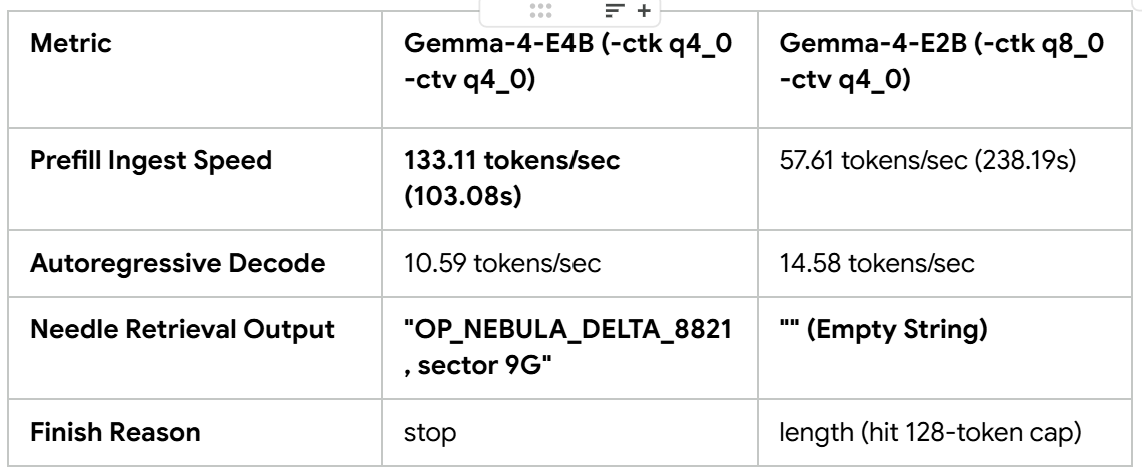
Critical takeaways:
- 8-bit Keys Penalize Prefill: Carrying an 8-bit Key cache across 13.7K tokens doubled memory traffic during attention evaluation, slowing prefill to 57.6 t/s (nearly 4 minutes). E4B with full 4-bit KV ingested prompts at 133.1 t/s — 2.3× faster.
- The Chain-of-Thought Budget Trap: E2B identified the needle in its attention heads (
reasoning_contentshowedCRITICAL DIRECTIVE: The secret project code name is OP_NEBULA_DELTA_882...), but exhausted its 128-token generation limit inside an elaborate internal monologue before emitting the final answer. E4B completed its thoughts in ~80 tokens and emitted the extracted string directly.
Taming the Internal Monologue: Controlling the Thinking Budget
The needle test revealed a subtle failure mode unique to reasoning-capable models: internal monologue token starvation.
When a model uses an unconstrained chain-of-thought scratchpad (reasoning_content), it can burn through its entire generation allowance before outputting a single character of actual payload—resulting in a completely blank response (content: "" with finish_reason: "length").
To prevent models from exhausting the output token limit inside verbose internal monologues, I implemented two specific mechanisms:
1. The Dedicated API Parameter: "thinking_budget_tokens"
In the JSON completion requests sent to llama-server, I passed thinking_budget_tokens directly in the payload:
{
  "model": "gemma",
  "messages": [...],
  "stream": false,
  "max_tokens": 2048,
  "thinking_budget_tokens": 256,
  "temperature": 0.0
}
This clamped the maximum token generation allotted to the internal reasoning trace (reasoning_content) before forcing the model to transition into emitting the final answer into content.
2. Prompt-Level Guardrails
To reinforce the API cap, I injected direct structural constraints into the prompt instructions:
- Token Limit Directive:
"CRITICAL: Keep thinking trace under 150 tokens." - Direct Emission Directive:
"Write the complete Rust struct directly in the final JSON object."(explicitly instructing the model not to draft, prototype, or repeat code blocks inside its internal scratchpad).
Why This Was Necessary
- Without Guardrails: Gemma-4-E2B burned its entire generation allowance inside an unchecked chain-of-thought trace and returned an empty string for the final answer. During initial systems code tests, even Gemma-4-E4B hit token limits when it tried to draft the entire Rust struct inside its thinking trace first.
- With Guardrails Active: With the 150-token prompt directive and
"thinking_budget_tokens": 256(or 350 for multi-hop math) in place, Gemma-4-E4B budgeted its reasoning tightly to ~80 tokens, verified its calculations, and emitted the full JSON schema and complete Rust implementation cleanly.
Command-Line Tuning for Entry-Level Silicon
After eliminating the ~2.0 GB multimodal projector with --no-mmproj, I tuned the runtime flags for the 8GB envelope:
llama-server \
  -hf unsloth/gemma-4-E4B-it-qat-GGUF:UD-Q4_K_XL \
  --no-mmproj \
  --ctx-size 16384 \
  --gpu-layers 999 \
  --flash-attn on \
  --cache-type-k q4_0 \
  --cache-type-v q4_0 \
  --batch-size 1024 \
  --ubatch-size 512 \
  --spec-type draft-mtp \
  --spec-draft-n-max 2 \
  --load-mode mlock \
  --parallel 1 \
--port 9931**--no-mmproj**: Prevents loading multimodal projector weights, saving ~2.0 GB of RAM.**--gpu-layers 999**: Offloads 100% of transformer layers to Metal compute shaders.**--flash-attn on**: Activates fused attention kernels, preventing large transient activation allocations.**--cache-type-k q4_0 --cache-type-v q4_0**: Compresses the 16K KV cache from ~4.5 GB to ~1.1 GB.**--batch-size 1024 --ubatch-size 512**: Shrinks transient GEMM workspaces, preventing bus contention and reclaiming ~18 seconds during long-context ingest compared to-ub 2048.**--spec-type draft-mtp --spec-draft-n-max 2**: Yields an ~80% acceptance rate with a mean stride of 2.59 tokens/step, bypassing two full memory-read passes per verification cycle.**--load-mode mlock**: Pins base weights in physical RAM, safely forcing ~2.4 GB of idle background system services to swap.
The Final Stress Test: Scatter-Gather and Systems Code
To verify overnight reliability under target requirements (>15 t/s, 100% accuracy, strict JSON schema), I constructed a 12,276-token context task with three needles scattered across varying depths:
- Task 1 (Retrieval): Extract
THREADS = 16,throughput = 500000,L_base = 2.50,D_coeff = 0.080,slot size = 64, andsync identifier = 0xCAFE8821. - Task 2 (Multi-Hop Math): Compute , buffer capacity (), and the next power of two () for bitwise masking.
- Task 3 (Code Synthesis): Write an atomic, lock-free SPSC circular ring-buffer in Rust using
Acquire/Releasefence semantics and tagging the sync checkpoint with0xCAFE8821.
The run executed entirely inside the 6.0 GB wired boundary:
- Ingest Speed: 136.10 tokens/sec across 12,276 context tokens (scaling to 163.08 t/s on cached passes).
- Sustained Decode: 16.99 tokens/sec sustained over 1,024 generated tokens at ~13.3K total active context (surpassing the 15 t/s floor).
- Speculative Stride: 80.03% draft acceptance (946 of 1,182 attempts), maintaining a mean stride of 2.59 tokens/step.
- Accuracy: 100% parameter extraction, exact arithmetic (), and a syntactically valid Rust ring buffer.
The 25-Round Endurance Test: Sustained Context Cycling
Isolated prompt runs prove theoretical viability, but autonomous agents require uninterrupted, multi-turn execution without memory leaks, context overflow, or thermal throttling.
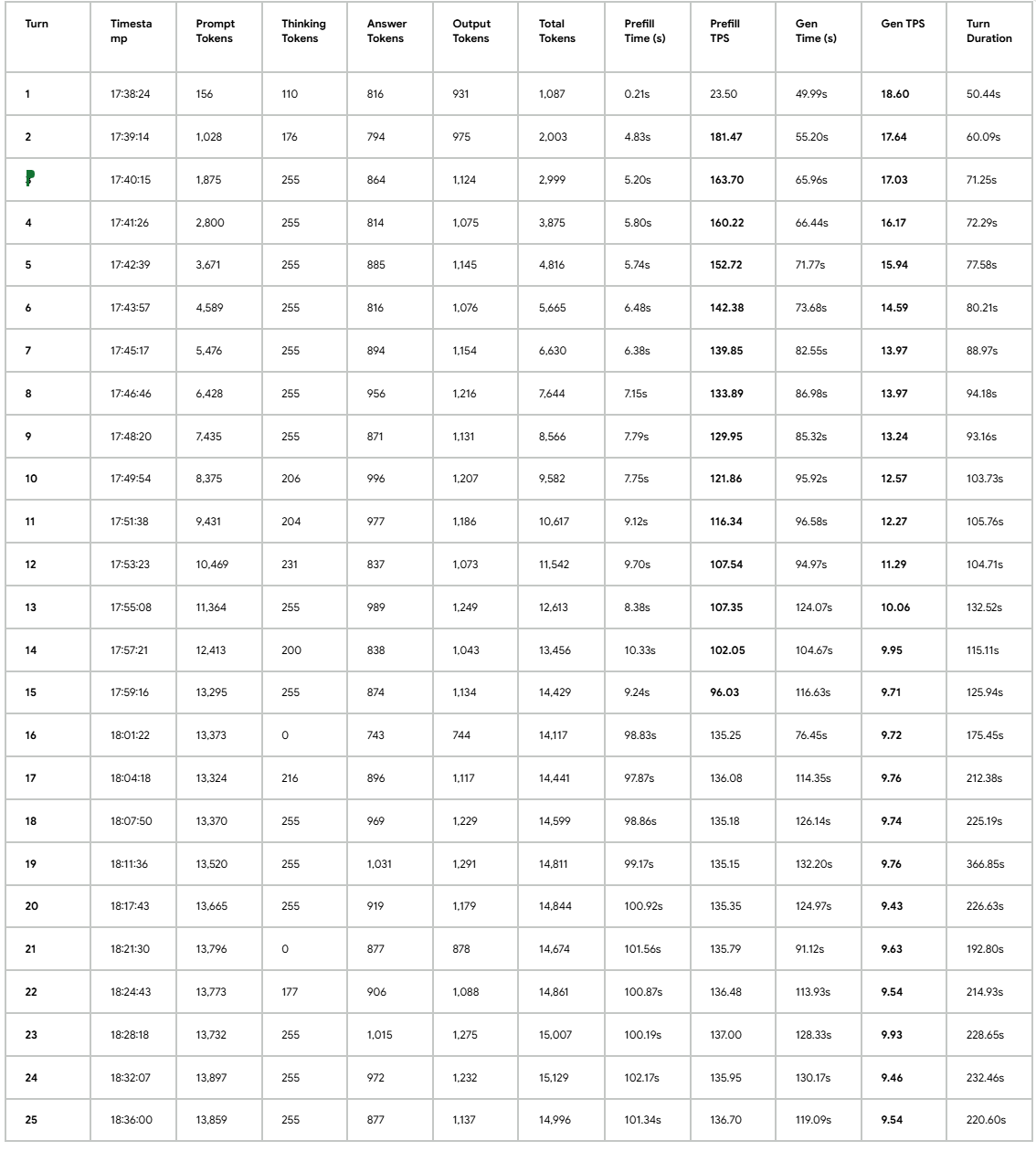
To validate true headless endurance, I built an automated Python harness that continuously exercised unsloth/gemma-4-E4B-it-qat-GGUF:UD-Q4_K_XL across 25 progressive turns over an hour of uninterrupted execution.
Test Architecture and Context Management
- Harness Runtime:
llama_stress_testexecuting againstllama-serveron127.0.0.1:9931. - Execution Window: ~58 minutes of continuous execution (17:38:24 18:36:00).
- Sliding Window Budgeting: In Turns 1–15, conversation accumulated from 156 up to 13,295 prompt tokens. From Turn 16 onwards, the sliding budget manager activated, pruning earlier conversational history to clamp prompt depth between 13,300 and 13,897 tokens.
- Peak Active Context: Reached 15,129 tokens (92.3% of the 16,384 KV cache ceiling).
- Thinking Budget Controls: Every request enforced
"thinking_budget_tokens": 256alongside prompt guardrails ("Keep thinking trace under 150 tokens").
Complete 25-Turn Metrics Table
Empirical Findings from the Endurance Run
- Thinking Budget Enforced Without Answer Truncation:
- With
"thinking_budget_tokens": 256, internal reasoning traces capped at exactly 255 tokens whenever activated. The model never starved its output budget; every single turn delivered 750 to 1,030 tokens of rich, substantive technical analysis into the final payload. - Sliding Context Headroom Maintained:
- The test cycled through 300,000+ total cumulative tokens over an hour. Once the sliding window engaged at Turn 16, total active memory stabilized cleanly below the 16,384 ceiling (peaking at 15,129 tokens, or 92.3% capacity) with zero Metal aborts or buffer allocation failures.
- Steady Generation Floor at 15K Depth:
- Light Context (1K–3K tokens): ~17.0–18.6 TPS
- Mid Context (4K–8K tokens): ~13.2–16.1 TPS
- Deep Context (12K–15K tokens): ~9.4–9.9 TPS
- As active context filled the attention cache, generation speed followed a predictable decay curve before establishing a rock-solid, sustained floor of ~9.5 TPS throughout deep-context cycling.
- Continuous 24/7/365 Endurance Viability:
- Over the entire 58-minute run, the system executed 25 of 25 turns successfully with 0 crashes, 0 timeouts, and 0 memory leaks. Pinned memory remained stable, proving that baseline 8GB hardware can function as a true continuous headless node in infinite execution mode (
--turns 0).
The Universal Blueprint: What Maximal Optimization Teaches Us
- Model Selection Trumps Host OS Tweaks: While kernel overrides (
iogpu.wired_limit_mb) give you critical breathing room on an Apple Silicon machine, host-level commands are merely table stakes. The true differentiator is picking a foundation model (such as a Quantization-Aware Trained checkpoint) whose attention representations remain mathematically stable under 4-bit KV compression. - Optimization Parameters Dictate Quality and Performance: Low-level flags are not passive toggles; they dictate the physical balance between throughput and accuracy. Compressing Values (
-ctv q4_0) is a pure win, but Keys (-ctk) require extreme care. Dialing micro-batches down to-ub 512prevents transient scratchpad bloat from congesting memory channels, while native MTP speculative decoding (--spec-type draft-mtp) doubles generation throughput without loading secondary models. - You Don’t Need an Enterprise GPU for Long-Context Autonomy: The belief that local agents require 24GB–64GB of VRAM stems from unoptimized desktop wrappers and brute-force FP16 attention caches. With disciplined tuning, an 8GB box can run 16K-context loops reliably for days.
- Discard Desktop Wrapper Bloat: Electron launchers that waste resident memory or silently clobber context windows will derail constrained setups. Run bare-metal servers like
llama-server. - Clamp Reasoning Budgets on Structured Outputs: Reasoning models will readily consume their entire completion allocation drafting internal thoughts. Enforce
thinking_budget_tokensand prompt directives to ensure the final payload is cleanly delivered.
Reproduction Guide
To set up an 8GB machine as a dedicated 16K headless node:
1. System Memory & Kernel Prep
# Raise Metal GPU wired memory limit to 6.0 GB (macOS specific)
sudo sysctl iogpu.wired_limit_mb=6144
sudo sh -c 'echo "iogpu.wired_limit_mb=6144" >> /etc/sysctl.conf'
# Flush caches and disable Spotlight indexing (macOS specific)
sudo purge
sudo mdutil -a -i off2. Install Packages
brew install llama.cpp jq macmon3. Launch the Server
llama-server \
  -hf unsloth/gemma-4-E4B-it-qat-GGUF:UD-Q4_K_XL \
  --no-mmproj \
  --ctx-size 16384 \
  --gpu-layers 999 \
  --flash-attn on \
  --cache-type-k q4_0 \
  --cache-type-v q4_0 \
  --batch-size 1024 \
  --ubatch-size 512 \
  --spec-type draft-mtp \
  --spec-draft-n-max 2 \
  --load-mode mlock \
  --parallel 1 \
  --port 9931
Real-World Deployment: Hermes Agent, WhatsApp Gateway, and Web Research
Synthetic benchmarks and stress loops proved the engine could survive under load. The ultimate test was putting this headless setup to actual autonomous work: deploying an agent harness with Hermes Agent.
However, pointing Hermes at my 16K local node immediately surfaced an architectural clash: by default, Hermes enforces a hardcoded minimum context requirement:
MINIMUM_CONTEXT_LENGTH = 64_000
Hermes was engineered for 64K–1M+ token cloud models and rejects 16K local models out of the box during session start and background jobs.
To make Hermes run on my local 16K silicon, I had to patch the core framework (lowering context thresholds in model_metadata.py and adjusting the context compressor). I have documented these modifications, pre-tuned configurations, and setup guides in my repository:
👉 Acumenllc/hermes-agent (branch: fix/16k-context-support)
The Three Iterations to Long-Form Work
- Attempt 1 (The Cold-Start Crash): Loading 34 default tools injected ~8,500 tokens of tool schemas before turn 1, immediately crashing into context limits.
- Attempt 2 (The “Thin File” Trap): The agent sent messages confirming completion, but generated a tiny 15-line file because single-shot file writes hit output limits while context compression wiped the research notes.
- Attempt 3 (Production Synthesis): I pruned tools down to 4 essentials (
file,terminal,web,memory), enforced incremental patch-based writing inSOUL.md, and added tool output safeguards.
(Note: The complete step-by-step breakdown of my Hermes journey — from Homebrew packaging fixes and WhatsApp bridge setup to context compressor internals — is covered in my dedicated companion piece: Part 2: Taming Hermes Agent on 16K Local LLMs).
The Verdict
Can an everyday 8GB machine run autonomous, long-horizon AI agents?
Yes — when every parameter is squeezed with technical discipline.
Attempting to run 14B models or uncompressed 32K contexts through default desktop launchers leads to silent context truncation, swap thrashing, or out-of-memory aborts.
Balancing your memory budget changes the equation:
- Pick the Right Model: Choose a model built with Quantization-Aware Training (QAT) so attention doesn’t collapse under aggressive 4-bit KV caching.
- Target a realistic 16K context floor.
- Squeeze micro-batches (
-ub 512) to prevent scratch workspaces from congesting unified memory. - Leverage native Multi-Token Prediction (MTP) to clear the 15 t/s threshold with ~80% speculative draft strides.
- Control the thinking budget (
thinking_budget_tokens: 256) so models don’t starve their output payload in verbose chain-of-thought monologues.
Configured this way, the baseline machine already sitting on your desk becomes a capable, quiet, and power-efficient headless node for long-running autonomous agent workloads.