

Embeddings are a foundational concept in machine learning and natural language processing (NLP). They provide a way to represent data, particularly text, in a numerical form that can be efficiently processed by machine learning algorithms. Two prominent types of embeddings are dense embeddings and sparse embeddings. This article will explore these two types, discussing their differences, strengths, weaknesses, and applications in modern NLP systems.
This discussion is structured as follows:
-
Understanding Embeddings
-
Introduction to Sparse Embeddings
-
Introduction to Dense Embeddings
-
Key Differences Between Sparse and Dense Embeddings
-
Use Cases and Applications
-
Performance Trade-offs
-
Future Trends and Developments
-
Conclusion
— -
Understanding Embeddings
Embeddings are vectors that represent data in a continuous space. In NLP, embeddings typically represent words, phrases, or sentences, allowing them to be processed mathematically. These representations are useful because they enable semantic reasoning and capture relationships between different data points. The key idea is to convert complex, high-dimensional data into lower-dimensional vectors while preserving meaningful relationships.
For example, in word embeddings, words that are semantically similar (like “king” and “queen”) should have vector representations that are close to each other in the embedding space.
Introduction to Sparse Embeddings
Sparse embeddings are a type of embedding where the majority of values in the vector are zero. These embeddings are generally high-dimensional, with most dimensions inactive or zero. Sparse embeddings were among the earliest forms of word representation in NLP, prominently seen in techniques like one-hot encoding and bag-of-words models.
Key Characteristics of Sparse Embeddings
-
High Dimensionality: Sparse embeddings often involve vectors with thousands or even millions of dimensions. For example, in a one-hot encoding for a vocabulary of 10,000 words, each word is represented by a 10,000-dimensional vector with a single “1” and 9,999 “0s”.
-
Locality: Sparse embeddings tend to represent each word independently. There is little overlap or shared information between the embeddings for different words.
-
Interpretability: Sparse embeddings are more interpretable since each dimension usually represents a specific feature (e.g., the presence or absence of a specific word).
Techniques Involving Sparse Embeddings
-
One-Hot Encoding: A simple form of sparse embedding where each word in the vocabulary is represented as a vector of zeros with a single “1” in the position corresponding to the word.
-
Bag-of-Words (BoW): A technique where each document is represented as a sparse vector, with each dimension corresponding to the count of a particular word in the document.
-
TF-IDF (Term Frequency-Inverse Document Frequency): A technique that enhances BoW by assigning weights to words based on their frequency in a document relative to their frequency across all documents. The resulting vectors are still sparse but more informative than simple BoW vectors.
Advantages of Sparse Embeddings
-
Simplicity and Interpretability: Sparse embeddings are straightforward to implement and understand. Each dimension corresponds to a specific feature or word, making it easy to interpret the embedding.
-
Exact Representation: Sparse embeddings capture the exact presence or absence of features (e.g., words) without approximations.
-
Good for High-Dimensional Data: When dealing with large vocabularies, sparse embeddings can be more memory-efficient because most of the values are zero and can be stored using sparse matrix representations.
Limitations of Sparse Embeddings
-
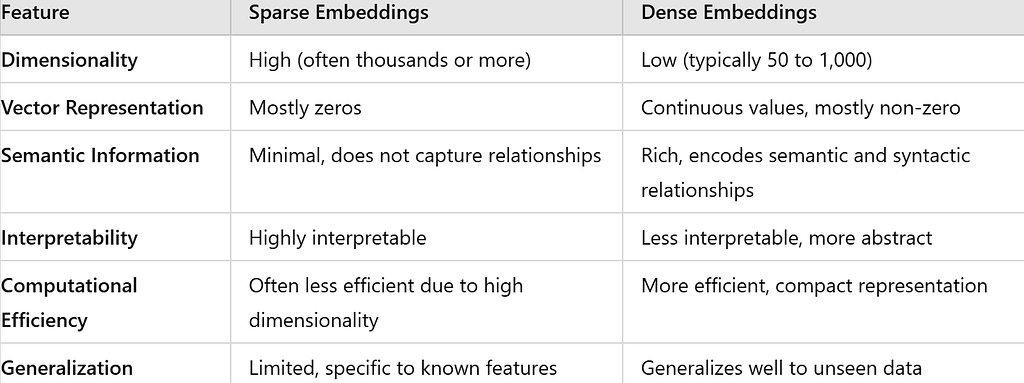
High Dimensionality: The large number of dimensions can be computationally expensive and lead to inefficiencies in storage and processing.
-
Lack of Semantic Information: Sparse embeddings do not inherently capture semantic relationships between words. For example, “king” and “queen” would be represented as orthogonal vectors with no indication that they are semantically related.
-
Poor Generalization: Sparse embeddings do not generalize well to unseen words or documents, making them less effective in tasks that require semantic understanding.
Introduction to Dense Embeddings
Dense embeddings, in contrast, represent data as lower-dimensional vectors where every value is non-zero (or near-zero). These embeddings are compact and encode more complex relationships between data points. Dense embeddings became popular with the advent of techniques like word2vec, GloVe, and, more recently, transformer-based models like BERT and GPT.
Key Characteristics of Dense Embeddings
-
Low Dimensionality: Dense embeddings are typically much lower in dimensionality compared to sparse embeddings, often ranging from 50 to 1,000 dimensions.
-
Distributed Representations: Unlike sparse embeddings, where each dimension represents a distinct feature, dense embeddings distribute information across all dimensions. Each dimension captures some aspect of the data’s meaning.
-
Semantic Relationships: Dense embeddings capture semantic relationships between data points. In word embeddings, words that are similar in meaning (e.g., “king” and “queen”) will have vectors that are close in the embedding space.
Techniques Involving Dense Embeddings
-
word2vec: A popular method introduced by Google, word2vec learns dense embeddings by predicting the context of words in a corpus (Skip-gram) or by predicting a word given its context (CBOW).
-
GloVe (Global Vectors for Word Representation): GloVe captures global word co-occurrence statistics and produces dense embeddings that reflect the relationships between words.
-
BERT (Bidirectional Encoder Representations from Transformers): BERT uses transformer networks to generate dense contextual embeddings, where the meaning of a word depends on its surrounding context.
Advantages of Dense Embeddings
-
Compact Representations: Dense embeddings require fewer dimensions, making them more memory-efficient and faster to process than sparse embeddings.
-
Semantic Richness: Dense embeddings capture nuanced relationships between words, such as analogies (e.g., “king” is to “queen” as “man” is to “woman”).
-
Generalization: Dense embeddings can generalize better to new data, as they capture underlying patterns and relationships rather than just surface-level features.
-
Adaptability to Complex Models: Dense embeddings are well-suited for deep learning models, enabling more sophisticated applications like sentiment analysis, machine translation, and text summarization.
Limitations of Dense Embeddings
-
Lack of Interpretability: Dense embeddings are less interpretable than sparse embeddings. It is difficult to pinpoint what each dimension represents, making them more of a “black box.”
-
Training Complexity: Generating dense embeddings often requires complex training procedures and large datasets. Models like BERT require significant computational resources and time to train.
-
Overfitting Risk: Dense embeddings, particularly in overparameterized models, can be prone to overfitting if not properly regularized.
Key Differences Between Sparse and Dense Embedding
Use Cases and Applications
Sparse Embeddings
-
Document Classification: Sparse embeddings like TF-IDF are often used in traditional document classification tasks, especially when interpretability is important.
-
Search and Information Retrieval: Sparse embeddings are widely used in search engines, where the focus is on exact keyword matching and relevance scoring.
-
Text Mining and Feature Extraction: In exploratory text mining, sparse embeddings can be useful for feature extraction and identifying the most important terms in a corpus.
Dense Embeddings
-
Sentiment Analysis: Dense embeddings are crucial in sentiment analysis, enabling models to understand nuanced expressions of sentiment that sparse methods miss.
-
Machine Translation: Dense embeddings form the backbone of modern machine translation systems, allowing them to capture complex relationships between languages.
-
Question Answering and Chatbots: Dense embeddings are used in conversational AI to understand context and generate coherent responses.
-
Recommendation Systems: Dense embeddings are applied in recommendation systems to capture user preferences and item features in a unified space.
Performance Trade-offs
Storage and Computational Requirements
Sparse embeddings can be more storage-efficient when dealing with extremely large vocabularies due to their high dimensionality but sparse nature. However, this efficiency often comes at the cost of computational complexity. Dense embeddings, while requiring more complex models to generate, offer better computational efficiency in many scenarios due to their lower dimensionality.
Interpretability vs. Expressiveness
Sparse embeddings provide clear, interpretable representations, making them useful in applications where transparency is key. Dense embeddings, however, excel in capturing complex, abstract relationships that sparse embeddings miss. This trade-off between interpretability and expressiveness is a key consideration when choosing between these methods.
Model Generalization
Dense embeddings typically generalize better across tasks and domains. They can capture context and relationships that sparse embeddings overlook. Sparse embeddings, while effective in well-defined domains, struggle with tasks requiring broad generalization.
Future Trends and Developments
The field of embeddings continues to evolve. Some of the emerging trends include:
- Hybrid Models: Combining the strengths of sparse and dense embeddings is an
area of active research. Hybrid approaches can leverage the interpretability of sparse methods with the expressiveness of dense models.
-
Contextual Embeddings: Advances like BERT and GPT continue to push the boundaries of dense embeddings, enabling even deeper understanding of language. These models are moving towards fine-tuning dense embeddings for specific tasks, improving performance and accuracy.
-
Multimodal Embeddings: There is increasing interest in embeddings that can incorporate multiple modalities, such as text, images, and audio, within a unified embedding space.
-
Efficient Training and Inference: As dense embeddings become more prevalent, there is a growing focus on optimizing the training and inference processes to make these methods more accessible and less resource-intensive.
Conclusion
Both sparse and dense embeddings play crucial roles in the landscape of NLP and machine learning. Sparse embeddings, with their high dimensionality and interpretability, remain relevant in traditional applications like information retrieval and feature extraction. Dense embeddings, on the other hand, offer powerful tools for capturing rich semantic relationships, making them indispensable in modern NLP tasks such as translation, sentiment analysis, and conversational AI.
The choice between sparse and dense embeddings depends on the specific requirements of the task, including factors like interpretability, dimensionality, and the need for semantic understanding. As research continues, the line between these two approaches is blurring, with hybrid models and context-aware embeddings becoming increasingly prominent. Regardless of the approach, embeddings will remain at the heart of how machines understand and process language.
Interested in discussing this further on a quick call? https://bit.ly/mlcal
Mohammed Lokhandwala Managing Partner, Acumen Cognitive Engineering US +1 (805) 222 0070 India +91 9833367577
Acumen | LinkedIn (https://www.linkedin.com/company/acumen-cognitive) Acumen Cognitive Engineering (https://acumen.llc)